
The SKAO, established in January 2021, is the world’s second intergovernmental organisation to be dedicated to astronomy. Headquartered in the UK on the grounds of the Jodrell Bank UNESCO World Heritage Site with sites in Australia and South Africa, the SKAO is tasked with building and operating the two largest and most complex radio telescope networks ever conceived to address fundamental questions about our universe. The SKAO already harnesses the talents of hundreds of scientists around the world and expects to spend around €2bn to complete construction by 2030 and run the observatory until then.
SKAO has now progressed into its construction stage to build the world’s two largest and most complex networks of radio telescopes, and consultants from Observatory Sciences have been selected to join the software teams working on the project.
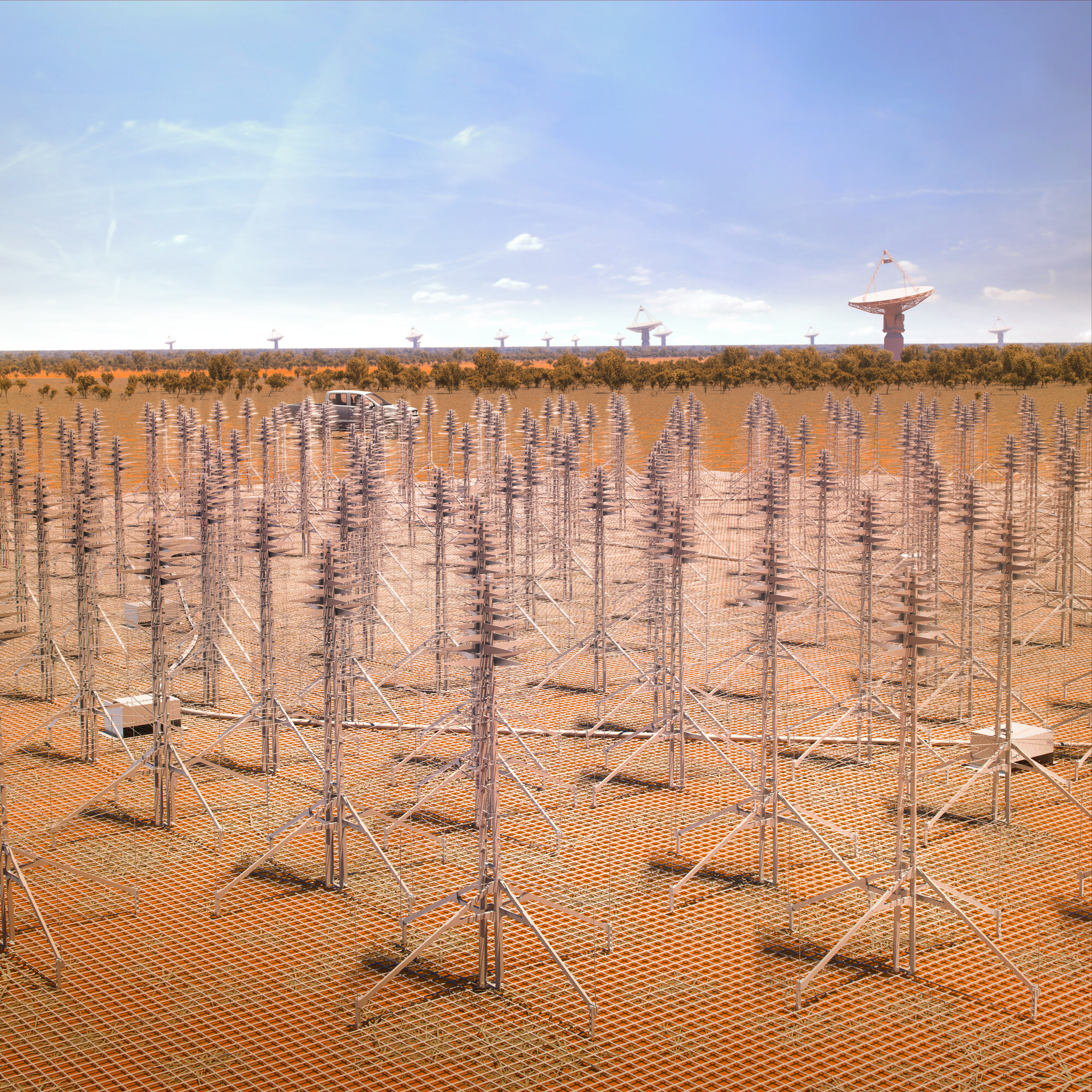
The two SKA telescope arrays, located 9,000km (5,600miles) apart in Western Australia and South Africa, are made up of hundreds of dishes and field stations. In Australia, there will be over 130,000 antennas by the end of construction, which must operate together and feed petabits of real-time data to central supercomputer control systems. The Observatory Sciences team are currently working on the Monitor, Control and Calibration System (MCCS) software for the SKA-Low telescope.
The MCCS is a complex monitoring and control software system in charge of the overall data acquisition of the telescope. It is designed to configure and constantly monitor and calibrate the antennas so that they all work together with one another and with the beam forming equipment. To simplify this the antennas’ signals are collected in groups of 16, then a field-programmable gate array splits the combined signal into 384 frequency bands, performs complex gain calculations and recombines them to create multiple virtual beams from each field station.
Once operating, the SKA will provide unrivalled scope in observations, exceeding the sensitivity, resolution, and survey speed of the best radio telescopes around today. With the recently-launched James Webb Space Telescope covering the infrared and far infrared spectrum and the suite of extremely large optical telescopes being built over the coming decade to capture visible light, the SKA will perfectly augment, complement and lead the way in scientific discovery and innovation.